
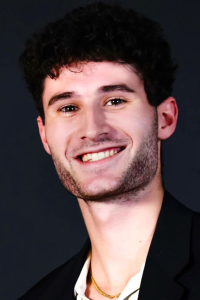
 When Jacob Kaplan ’28 encounters a challenge, he doesn’t see an obstacle—he sees an invitation to create. From building custom apps to engineering high-performance bikes to reimagining prescription eyewear, the iSchool student has a track record of turning ambitious ideas into practical solutions.
Kaplan, who grew up in Vienna, Virginia, is guided by a natural knack for tech, curiosity, and a willingness to fail that he learned from his father and uncle, two of his most important role models—and Syracuse alumni.
His father, Seth Kaplan ’94, a graduate of the College of Arts and Sciences, spent years doing government contract work and later worked in the health sector before joining Kaplan’s grandfather to run the family’s commercial real estate company. Along the way, he passed on a deep knowledge of coding to his son. “My dad is the best coder I know, other than myself,” Kaplan said. “He basically taught me everything I know about technology.”
His uncle, Philip Kaplan ’97, an iSchool graduate and founder of music distribution company DistroKid, offered another perspective. “He taught me about the more niche side of technology,” Kaplan said. “I’m very fortunate to have a lot of really successful role models in my family.”
During the COVID-19 pandemic, Kaplan used his time to build a technical foundation, teaching himself new programming languages through YouTube tutorials and taking apart phones and computers to understand how they worked. “I was trying to focus on my future skills,” he said.
As his abilities grew, he began to define his own angle—less focused on engineering and more on technology’s broader role in society. “My interest is in how to manage technology’s impact on the world, the bigger picture,” he said.
At the iSchool, Kaplan has been exploring how to turn his ideas into reality with advice, funding, and workspace from programs such as the Couri Hatchery Student Business Incubator, the Raymond von Dran Incubator, and the Blackstone LaunchPad. These programs, along with faculty mentors and classmates have been “incredibly supportive,” he said, helping him refine concepts and move projects forward.
Among them is The OtherGlasses, for which he received a grant from the Fall 2025 Orange Innovation Fund. The startup centers on what he calls “the next generation of eyewear”—adjustable prescription glasses that use tunable liquid-crystal lenses fitted into standard frames, allowing wearers to change their vision on the fly without switching between multiple pairs.
The idea evolved from Kaplan’s earlier interest in augmented reality and his fascination with VR headsets. He has tested nearly every wearable model he could find. “They were all doing the same thing, trying to replace the phone,” he said. “But I don’t think anyone can be convinced to get rid of their phone yet. Everyone’s glued to it.”
For now he is focusing on practical vision solutions before he will eventually expand into a separate AR device designed to enhance—rather than replace—the way people experience information. “It’s going to be so seamless and feel amazing,” he said.
The OtherGlasses is just one of many projects competing for Kaplan’s attention. He is currently developing six apps simultaneously, including a productivity platform for students, an app designed to support individuals struggling with eating disorders, and a task management tool aimed at simplifying daily organization.
Outside of software, his curiosity spills into nearly every corner of his life. He has taught himself to play guitar, competed in the ZAP Skimboarding World Championships three years in a row, and rebuilt vehicles, including transforming a Razor SX500 electric minibike from a standard kids’ model into a high-performance machine.
The throughline, he said, is not being afraid to make mistakes. “Failing in an industry like mine is so common that you kind of just get over yourself after a while,” Kaplan said. “I’ve tried projects. I’ve failed, and I’ve needed help. And then when you do succeed, you realize you can do it again 100 times.”