
Key Takeaways
- Data science vs. AI represents a distinction worth understanding clearly: data science focuses on extracting insights from data, while AI focuses on building systems that can act and learn autonomously.
- Machine learning sits at the intersection of both AI and data science. It’s a subset of AI and one of the most powerful tools data scientists use.
- Both data science and AI use Python as their primary language, but their toolkits, day-to-day responsibilities, and career paths diverge significantly from there.
- The right path when choosing between AI and data science depends on whether you’re drawn to analysis and storytelling with data, or to building intelligent systems and deploying software.
If you’ve tried to research both fields, you’ve probably run into the same problem: data science and artificial intelligence are treated as interchangeable in some places and completely separate in others. Neither framing is quite right.
Data science vs. AI is one of the most searched comparisons in tech education. And that’s not surprising, considering both fields revolve around data and both offer strong growth, competitive salaries, and intellectually challenging work. However, they’re built around different goals, different toolsets, and different day-to-day responsibilities. When those differences get blurred, it’s easy to end up choosing the wrong course path, the wrong degree program, or even the wrong job to pursue.
This article breaks down what each field actually involves, from core definitions and workflows to tools, career paths, and salary outlook, so you can make a clear, informed decision about which direction fits you best.
What Is Data Science?
Data science focuses on extracting knowledge and actionable insights from data, both structured (databases, spreadsheets) and unstructured (text, images, social media).
The work follows a recognizable process: collecting and cleaning data, exploring it for patterns, applying statistical and analytical methods, and communicating findings through visualizations and reports. The goal is to help humans make better decisions, not to automate those decisions away.
In practice, data scientists spend a significant portion of their time cleaning inconsistent data, reconciling different data sources, and building pipelines that make data usable. The analysis and modeling come after that foundation is solid.
What Is Artificial Intelligence?
Artificial intelligence is an area of computer science dedicated to creating systems that can handle tasks normally performed by humans, including understanding language, interpreting visual information, and making decisions on their own.
The types of AI currently in use are almost all examples of narrow AI: systems designed to do one specific thing exceptionally well. Your email spam filter, a facial recognition system, and a product recommendation engine are all narrow AI. General AI (systems with human-level reasoning across arbitrary tasks) remains theoretical and is not currently deployed anywhere.
What distinguishes AI from conventional software is adaptability. A traditional program follows fixed rules written by a programmer. An AI system learns from data, adjusts its behavior based on feedback, and can generalize to situations it hasn’t explicitly encountered before.
Data Science vs. AI: Key Differences
These fields share tools and vocabulary, which is part of why the confusion persists. But the core distinctions are clear once you look at goals, scope, and how each field uses data.
Goal
Data science seeks to find patterns and communicate insights. The end product is usually a report, a dashboard, or a recommendation that a person acts on.
AI seeks to build intelligence and autonomy. The end product is a system that acts on its own, classifying images, generating text, routing requests, or detecting fraud in real time.
Scope
Data science draws on statistics, probability, visualization, domain expertise, and communication. It’s broad by design.
AI is more narrowly focused on algorithms, model architecture, and implementation, specifically, how to make a machine learn and perform a task reliably at scale.
How data is used
In data science, data is examined to understand what happened, what’s happening now, and what’s likely to happen next. The analyst interprets.
In AI, data is used to train a model. The model internalizes patterns from millions of examples and uses them to make predictions or decisions on new inputs it’s never seen. The system learns.
| Aspect | Data Science | Artificial Intelligence |
|---|---|---|
| Primary Goal | Extract insights | Build intelligent systems |
| Output | Reports, dashboards, forecasts | Models, agents, autonomous systems |
| Data Role | Analyzed by humans | Used to train machines |
| Decision-maker | Human (informed by analysis) | System (acts autonomously) |
| Typical Methods | Statistics, visualization, SQL | ML algorithms, neural networks, NLP |
Where Data Science and AI Overlap
The intersection of these two fields is machine learning, and understanding it clarifies the relationship between the disciplines.
Machine learning is a subset of AI. It’s the method by which AI systems learn from data rather than following hard-coded rules. But machine learning is also a core tool in data science. Data scientists use ML algorithms to build predictive models, segment customers, forecast demand, and classify outcomes.
This overlap is why the fields get conflated. Both use Python. Both use scikit-learn. Both involve training models on historical data. The difference is in what happens next. A data scientist typically uses that model to generate an insight, like a projection, a segmentation, or a ranked list, that a human reviews and acts on. An AI specialist deploys that model into a production system where it makes decisions in real time, continuously, without a human in the loop for every output.
The relationship between data science vs. machine learning adds another layer: ML is one tool in the data scientist’s toolkit, not the whole job. Furthermore, AI in data science is growing, as data scientists increasingly use AI-powered tools to automate parts of their own analysis workflow, which further blurs the line between the two roles.
Comparing the Tools and Technologies
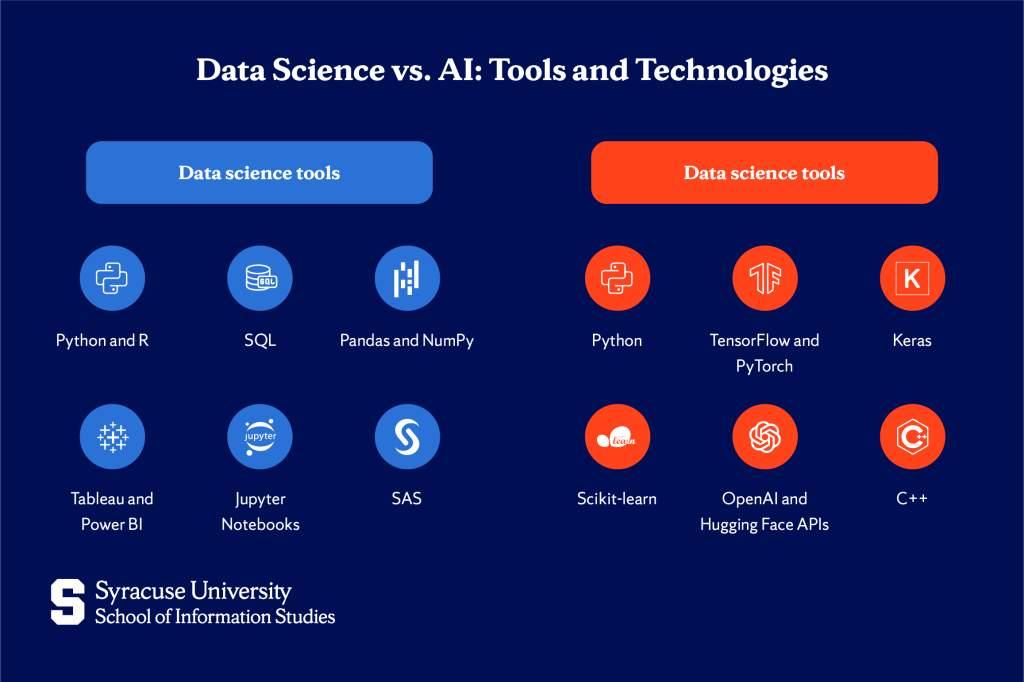
Both fields share Python as a common starting point, but after that, their tools and focus begin to branch in different directions.
Data science tools:
- Python and R: The two primary languages for statistical analysis and data manipulation.
- SQL: Essential for querying databases; still the most-used tool in a working data scientist’s daily routine.
- Pandas and NumPy: Python libraries for data manipulation and numerical computing.
- Tableau and Power BI: Visualization tools for building dashboards and communicating findings to non-technical stakeholders.
- Jupyter Notebooks: The standard environment for exploratory analysis and sharing documented work.
- SAS: Still widely used in healthcare, finance, and enterprise environments.
AI and ML tools:
- Python: Dominant in both research and production AI.
- TensorFlow and PyTorch: The two major deep learning frameworks. PyTorch is more common in research; TensorFlow is more common in production.
- Keras: A high-level API that simplifies building neural networks, typically running on top of TensorFlow.
- Scikit-learn: The go-to library for classical ML algorithms, used in both data science and AI.
- OpenAI and Hugging Face APIs: Used for integrating large language models into applications.
- C++: Relevant in performance-critical AI applications like robotics and embedded systems.
The practical implication: if you know Python and SQL well, you can move in either direction from there. The branching point is whether you go deeper into statistical analysis and visualization (data science) or into model architecture, deployment, and AI system development.
Career Paths: Data Scientist vs. AI Developer
The day-to-day reality of these roles is more distinct than the job postings sometimes suggest.
Data scientist
A data scientist’s work centers on questions. What’s driving customer churn? Which product features correlate with long-term retention? How accurate is this forecast model? They spend time wrangling data, running analyses, building predictive models, and presenting findings to stakeholders who need to understand and act on them. Communication and statistical rigor are as important as coding ability.
It’s also worth understanding where data scientist vs. data analyst roles diverge: analysts typically work with existing data and defined questions, while scientists often scope the questions themselves and build the models that answer them.
AI developer
An AI developer’s work centers on systems. They write code to train, evaluate, and deploy models, integrating them into applications, optimizing them for performance, and maintaining them in production. The work is closer to software development than to analysis. They’re thinking about scalability, latency, model drift over time, and how to build infrastructure that lets a model make millions of decisions reliably.
Required Skills and Education
Working in data science or AI requires a mix of technical knowledge, practical tools, and clear thinking. While the exact requirements vary by role, most positions build on the following skill areas.
Data science skills:
- Statistics and probability: They’re the theoretical foundation for understanding data patterns and model behavior.
- Data visualization and the ability to communicate findings clearly to non-technical audiences.
- SQL for querying and managing structured data.
- Python (Pandas, NumPy, scikit-learn) for data analysis and building models.
- Domain knowledge in your target industry (healthcare, finance, marketing, etc.).
AI skills:
- Software development fundamentals, understanding how production systems are built and maintained.
- Deep learning and neural network architecture.
- Linear algebra and calculus, essential for understanding how models learn.
- Cloud computing platforms (AWS, Google Cloud, Azure), where most AI systems are deployed and scaled.
- Familiarity with MLOps, the practice of deploying, monitoring, and maintaining models in production.
Education
Both fields are accessible through traditional degrees (computer science, mathematics, statistics) and non-traditional routes (bootcamps, self-directed learning, certifications from Google, DeepLearning.AI, or Coursera). Research-oriented AI roles, particularly at AI labs, still heavily favor advanced degrees. Applied roles in both fields increasingly prioritize demonstrated project work over credentials alone.
Which Career Is Right for You?
This comes down to where your natural interests sit, not which field sounds more impressive.
Choose data science if:
- You’re drawn to statistics, pattern recognition, and understanding why things happen.
- You enjoy storytelling with data, turning numbers into narratives that inform decisions.
- You want to work closely with business stakeholders and translate analytical findings into strategy.
- You’re interested in domains like healthcare analytics, financial modeling, or marketing intelligence.
- Learning more about how to become a data scientist resonates with how you see your career.
Choose AI if:
- You love building software systems and thinking about architecture and scale.
- Complex algorithms and optimization problems are genuinely interesting to you, not just necessary.
- You want to build things that run autonomously: systems that make decisions without human review on every output.
- You’re energized by technical challenges: deployment, latency, model drift, and production reliability.
- The path to becoming an AI developer aligns with where you want to go.
If you’re still weighing your options, take our quick “Which Career Fits You Better: Data Science or AI?” self-scoring quiz to see whether data science or AI aligns more closely with your interests and long-term goals.
If you are still unsure where to begin, start with data science fundamentals. The statistics, Python skills, and analytical thinking you develop there carry over directly into AI roles if you choose to specialize later.
Two Fields, One Direction
Data science and AI are not rivals; they’re symbiotic. AI systems need clean, well-structured data to learn from. Data science increasingly uses AI-powered tools to do the analysis work faster and at a greater scale. The most capable practitioners in both fields understand enough of the other to collaborate effectively.
Data science explains the past and present to inform human decisions; AI builds systems that act on their own. Machine learning is where they meet. Your skills, tools, and career trajectory diverge from that shared foundation based on which direction interests you more.
If you want a structured program that prepares you for the AI side of this spectrum, including building, deploying, and leading intelligent systems with both technical depth and human-centered design thinking, explore Syracuse University iSchool’s Applied Human Centered Artificial Intelligence Master’s Degree. Explore our program and see how you can build expertise at the intersection of both fields.
Frequently Asked Questions (FAQs)
Is AI replacing data science?
No, it’s changing what data scientists spend their time on. AI tools automate the routine parts of data work (cleaning, basic visualization, pattern detection), which frees data scientists to focus on higher-level analysis, model strategy, and stakeholder communication. The role is evolving, not disappearing.
Can a data scientist become an AI developer?
Yes, and it’s a common transition. Data scientists already know Python, ML algorithms, and model evaluation, so the foundation is there. The shift to AI development requires going deeper into software development, deployment infrastructure, and production system design. It’s a meaningful skill expansion, not a restart.
Is AI a subset of data science?
No, it’s closer to the reverse. Machine learning (a subset of AI) is a tool used within data science, which sometimes makes it seem like AI lives inside data science. But AI is the broader field of computer science aimed at building intelligent systems, while data science is a cross-disciplinary practice focused on extracting insights from data. They overlap significantly, but neither fully contains the other.
Which is harder to learn?
They’re hard in different ways. Data science requires statistical intuition and communication skills that take time to develop. AI development requires stronger software development skills and comfort with more advanced mathematics. Most people find whichever one aligns with their existing strengths easier to enter and more rewarding to persist in.