
Key Takeaways
- Top-paying AI positions range from strategic leadership roles, such as CAIO, to highly specialized technical roles like computer vision specialists and LLM experts.
- Educational requirements vary; PhDs are essential for research roles, while product managers often succeed with master’s degrees or strong portfolios.
- Many successful AI professionals start with bachelor’s degrees in computer science or related fields, work for 2-3 years gaining practical experience, then pursue master’s degrees to break into senior roles.
AI has moved fast, from an experimental technology to something that now sits at the center of business strategy across industries. And the job market reflects that shift. In Q1 2025 alone, the U.S. recorded 35,445 open AI roles, up 25.2% from the year before, with compensation packages that rival long-established tech giants. In some specialized roles, total pay can climb past $400,000 once equity and bonuses are factored in.
While high compensation attracts many professionals to the field, understanding which highest-paying AI jobs match your existing skills and career goals is critical. A research scientist role requiring a PhD in machine learning follows a very different path than an AI product manager position that values business acumen alongside technical understanding.
This guide breaks down the 10 highest-paying AI jobs, including realistic salary ranges, day-to-day responsibilities, required qualifications, and real barriers to entry. The goal is to help you see which roles make sense for where you are now, and which ones might be longer-term targets.
Top 10 Highest-Paying AI Jobs
The following roles represent the most lucrative positions in AI today, reflecting the difficulty of finding skilled professionals and the strong business value of the work involved.
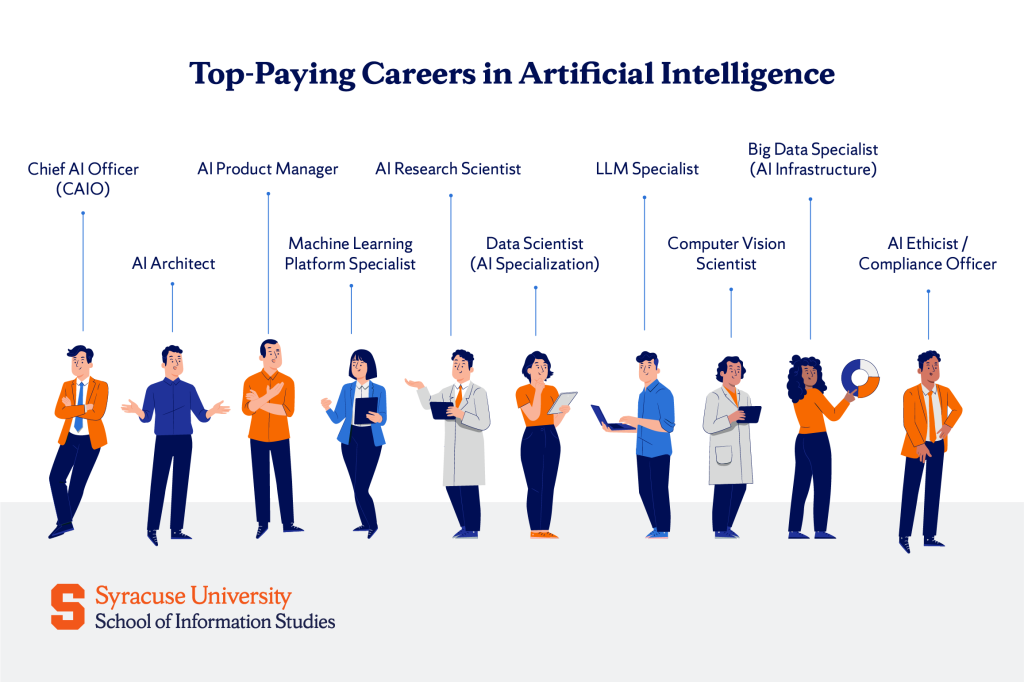
1. Chief AI officer (CAIO)
Salary range: $200 – $500,000+
What they do: Chief AI officers sit at the C-suite level, defining AI strategy across the entire organization. They decide which AI initiatives get funded, ensure ethical AI deployment, manage cross-functional teams, and report directly to the CEO on how AI drives competitive advantage. This role combines technical vision with business leadership and regulatory awareness.
Niche skills: AI governance frameworks, enterprise architecture, risk management, stakeholder communication at the board level.
Barrier to entry: Typically requires 15+ years of experience with at least 5-7 years in senior AI leadership roles. Most CAIOs have advanced degrees (master’s or PhD) plus proven track records building AI products that generated measurable business outcomes.
2. AI architect
Salary range: $90,000 – $180,000
What they do: AI architects are the city planners of AI systems. They design the overall infrastructure and ecosystem, deciding which models go where, how data flows between services, what cloud platforms to use, and how to scale systems to handle millions of users.
Niche skills: System design, cloud architecture (AWS SageMaker, Azure ML, GCP Vertex AI), MLOps, microservices architecture
Barrier to entry: Requires 10+ years of experience in software engineering with at least 5 years focused on AI/ML systems. Most architects have master’s degrees and deep expertise in distributed systems.
3. AI product manager
Salary range: $140,000 – $195,000
What they do: AI product managers bridge technical teams and business goals. They define product roadmaps, prioritize features, manage stakeholder expectations, and ensure AI products actually solve customer problems. While they are not expected to write production-level code, they must understand AI product lifecycles to make informed decisions about what’s feasible and valuable.
Niche skills: Product lifecycle management, A/B testing for AI features, ethical AI considerations, and user research specific to AI applications
Barrier to entry: Typically requires 5-8 years in product management with at least 2-3 years working on AI-powered products. An MBA or a master’s in related fields is common but not always required with a strong portfolio.
4. Machine learning platform specialist
Salary range: $105,000 – $150,000
What they do: These specialists focus on operationalizing machine learning models, ensuring they’re reliable, scalable, monitored, and integrated into real-world applications. They build the infrastructure that takes models from Jupyter notebooks to production systems serving millions of users. This includes setting up automated retraining pipelines, monitoring model performance drift, and ensuring models remain accurate as data changes.
Niche skills: ML deployment pipelines (Kubeflow, MLflow), model monitoring platforms, containerization, continuous integration/deployment for ML, feature stores
Barrier to entry: Requires 5-10+ years of hands-on ML production experience. Strong software development background plus deep understanding of machine learning workflows. Master’s degree preferred.
5. AI research scientist
Salary range: $105,000 – $170,000
What they do: Research scientists invent new algorithms and push the boundaries of what AI can do. They work at places like OpenAI, DeepMind, or university research labs, publishing papers that advance the field. This role focuses on discovering novel approaches rather than applying existing techniques to business problems.
Niche skills: Deep theoretical knowledge of types of AI, publishing in top-tier conferences (NeurIPS, ICML), PyTorch/TensorFlow for research, mathematical proof techniques
Barrier to entry: A PhD in computer science, mathematics, or a related field is virtually required. Most positions want publications in top conferences and evidence of groundbreaking research contributions.
6. Data scientist (AI specialization)
Salary range: $98,000 – $170,000
What they do: While entry-level data science roles pay well, AI-specialized senior data scientists command top-tier compensation. These professionals focus on predictive modeling using deep learning, work heavily with AI in data science applications, and build sophisticated recommendation systems, fraud detection models, and personalization engines. They differ from analysts who focus on dashboards and reporting.
Niche skills: Experience with deep learning frameworks, designing features for neural networks, structuring experiments, applying advanced statistics, and understanding the difference between AI and machine learning.
Barrier to entry: A master’s degree is expected for senior roles. Requires 4-6 years of experience with a proven track record of building models that drove business impact.
7. LLM specialist
Salary range: $125,000 – $170,000
What they do: LLM specialists work exclusively with large language models, the technology behind systems like ChatGPT and Claude. Their work includes applying methods such as retrieval-augmented generation that connect language models to knowledge bases, adapting models for specific domains, developing conversational AI systems, and refining prompt strategies. This area has become one of the most sought-after specializations due to rapid growth in generative AI.
Niche skills: Transformer architectures, fine-tuning LLMs (GPT, BERT, LLaMA), RAG implementation, semantic search, vector databases
Barrier to entry: Bachelor’s degree minimum, master’s preferred. Needs 3-5 years working specifically with NLP and recent hands-on experience with modern LLMs.
8. Computer vision scientist
Salary range: $94,000 – $137,000
What they do: Computer vision scientists build AI that sees and interprets the physical world. They work on autonomous vehicles (Tesla, Waymo), medical imaging diagnosis, facial recognition, quality control in manufacturing, and augmented reality. This specialization requires understanding both AI and the physics of how cameras capture images, plus highly specialized mathematics around geometry and 3D reconstruction.
Niche skills: OpenCV, convolutional neural networks (CNNs), 3D reconstruction, object detection frameworks (YOLO, R-CNN), understanding of camera geometry and photogrammetry.
Barrier to entry: Bachelor’s required, master’s or PhD preferred for research positions. Needs 3-5 years of experience plus a strong foundation in geometry, linear algebra, and physics.
9. Big data specialist (AI infrastructure)
Salary range: $130,000 – $240,000
What they do: AI systems consume massive amounts of data, and big data specialists build the pipelines that feed them. They design ETL (Extract, Transform, Load) processes, maintain data lakes, ensure data quality, and optimize storage for fast access. Without a strong data infrastructure, even the best AI models fail. They’re the backbone that makes AI possible.
Niche skills: Apache Spark, Hadoop, data pipeline orchestration (Airflow), SQL optimization, distributed computing, and real-time data processing.
Barrier to entry: Bachelor’s degree required. Needs 4-6 years of experience building data systems at scale, with recent focus on supporting AI/ML workloads.
10. AI ethicist / compliance officer
Salary range: $60,000 – $150,000
What they do: As AI regulation increases globally (EU AI Act, various state laws), companies pay premiums for experts who can prevent lawsuits, bias incidents, and reputational damage. These professionals audit AI systems for fairness, ensure compliance with regulations, develop ethical guidelines for AI development, and advise leadership on responsible AI practices. This role combines technical understanding with legal, philosophical, and policy expertise.
Niche skills: Bias detection and mitigation, AI regulations (GDPR, AI Act), fairness metrics, ethical frameworks, risk assessment.
Barrier to entry: Advanced degree in law, philosophy, public policy, or computer science with an ethics focus. Experience can substitute for formal education if you’ve led major AI ethics initiatives.
Essential Skills to Land a Six-Figure AI Role
Securing top-tier compensation requires a strong mix of technical skills and strategic soft skills that enable you to deliver real business value.
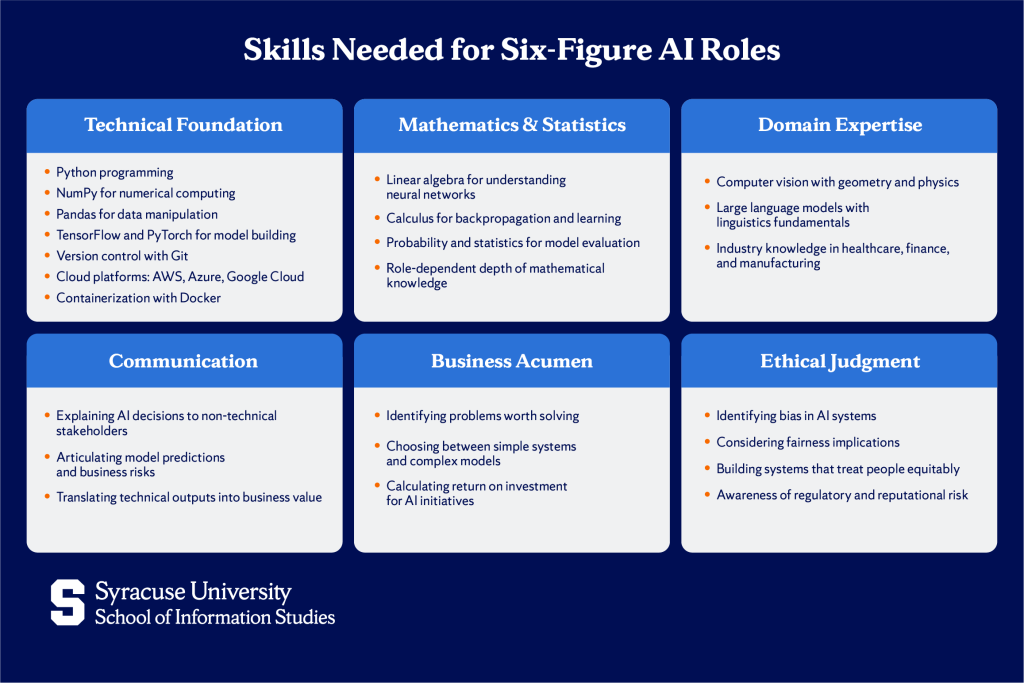
Technical foundation
Employers expect professionals to understand how models are developed, trained, and deployed in real environments, not just at a theoretical level. These core skills form the baseline that allows more advanced expertise to develop.
Programming & tools
Python dominates AI development, but mastery means you need to understand libraries like NumPy for numerical computing, Pandas for data manipulation, and frameworks like TensorFlow or PyTorch for building models. Proficiency with version control (Git), cloud platforms (AWS, Azure, or GCP), and containerization (Docker) separates professionals from hobbyists.
Mathematics & statistics
You can’t skip the fundamentals. Linear algebra helps you understand how neural networks process data. Calculus explains how models learn through backpropagation. Probability and statistics are essential for evaluating model performance and understanding when models are wrong. The depth required varies by role: research scientists need PhD-level math, while product managers need conceptual understanding.
Domain expertise
High-paying roles often require specialization. Computer vision scientists need geometry and physics. LLM specialists need linguistics fundamentals. Understanding the benefits of AI in specific domains (healthcare, finance, manufacturing) further increases your value to employers in those fields.
Soft skills that command premium pay
Technical ability alone rarely leads to top compensation. As AI systems influence business decisions, organizations value professionals who can explain outcomes, assess impact, and guide strategy. These skills determine whether AI work stays experimental or becomes central to how a business operates.
Communication
The ability to explain “black box” AI decisions to non-technical stakeholders is crucial for high compensation. Executives paying $200,000+ salaries expect you to articulate why a model made specific predictions, what business risks exist, and which investments will deliver ROI. Technical brilliance matters less if you can’t translate it into business value.
Business acumen
Understanding how AI creates value separates high earners from average performers. Can you identify which problems are worth solving? Do you know when a simple rule-based system beats a complex neural network? Can you calculate ROI on AI initiatives? These skills move you from order-taker to strategic partner.
Ethical judgment
As AI impacts more decisions (hiring, lending, healthcare), companies need professionals who can spot bias, consider fairness implications, and build systems that treat people equitably. This awareness isn’t just morally right; it’s financially essential as regulation increases and reputational risks grow.
Education & Pathways: Do You Need a PhD?
While advanced degrees are common in AI, the educational barrier to entry varies significantly depending on whether you want to build research models or manage commercial products.
Research scientist path
PhDs are virtually required for roles inventing new algorithms at places like OpenAI, DeepMind, or Meta AI Research. These positions value theoretical contributions, publications in top conferences, and deep expertise in specific subfields. The PhD signals you can conduct original research and push the boundaries of what’s possible.
Technical & product paths
Machine learning platform specialists, AI product managers, and most applied roles often succeed with bachelor’s degrees and strong portfolios or master’s degrees. Companies hiring for these positions care more about proven ability to deploy working systems than academic credentials. A degree like Syracuse University’s Master’s in Artificial Intelligence can accelerate your career without requiring years in research.
Self-taught & bootcamp routes
While challenging, self-taught professionals can break into AI with strong portfolios demonstrating real projects. However, most reach salary ceilings around $150,000-$180,000 without formal credentials. Certifications from Google AI, Stanford (Andrew Ng’s courses), or AWS can boost credibility when pivoting from other tech roles.
The hybrid approach
Many successful AI professionals start with bachelor’s degrees in computer science or related fields, work for 2-3 years gaining practical experience, then pursue master’s degrees to break into senior roles. This path combines practical skills with theoretical depth while minimizing time out of the workforce.
The truth is that educational requirements correlate with role type and seniority. Entry-level positions are more flexible about degrees if you demonstrate competence. Senior positions paying $200,000+ almost always require advanced degrees or exceptional track records that prove equivalent expertise.
Choosing Your AI Path
The highest-paying AI job isn’t the one with the biggest number, but the one that aligns with your strengths and the kind of work you enjoy. A research scientist earning $400,000 who hates writing academic papers will burn out faster than an AI product manager earning $180,000 who loves shaping product strategy.
Think about what genuinely keeps you engaged over time. Some people are energized by abstract problem-solving and mathematical depth, which points toward research-focused work. Others prefer seeing products reach users, shaping features, and learning directly from customer feedback, which aligns more closely with product-oriented roles. There are also paths centered on language and meaning, where understanding how machines process text becomes the core challenge. Each of these directions can lead to strong compensation; the real question is which kind of work you will still find rewarding years down the line.
Build projects that demonstrate real capability, contribute to open-source work, and document what you are learning. For those who want structured preparation alongside hands-on experience, the Master’s in Artificial Intelligence at Syracuse University can provide focused training that supports both technical growth and applied career paths.
Frequently Asked Questions (FAQs)
Is it too late to get into AI if I don’t have a computer science degree?
No, while CS degrees help, professionals with strong quantitative backgrounds (mathematics, physics, statistics) successfully transition into AI roles. Focus on building a portfolio of projects that demonstrate practical skills, consider a master’s program focused on AI, and target applied roles like ML platform specialists rather than research positions.
Which AI job has the lowest barrier to entry for high pay?
AI product managers and data scientists (with AI specialization) typically have lower technical barriers. Product managers can earn $100,000+ with strong business skills and basic technical understanding, while data scientists can transition from analytics roles by upskilling in machine learning frameworks.
Can I work remotely in these high-paying AI positions?
Yes, many AI roles support remote work, especially at tech companies that built distributed teams during the pandemic. However, the most competitive positions (especially at Big Tech and AI-focused startups) often prefer hybrid arrangements with some in-office collaboration, particularly for senior leadership and research roles.