
Key Takeaways
- AI developers need strong programming skills, mathematical foundations, and hands-on project experience.
- Structured education programs accelerate learning by teaching AI fundamentals, ethical frameworks, and career preparation.
- Building a portfolio with real projects is just as important as formal credentials.
- Salaries for AI developers are competitive, with experienced roles exceeding $150,000.
Technology changes fast, and some changes affect almost everything we do each day. AI is shaping how people shop, get medical care, manage money, and use everyday apps. If you’re curious about how those systems are built, becoming an AI developer puts you right at the center of that work.
This guide walks you through the process in a clear, practical way. It explains what you need to learn, how to build useful projects, which education paths make sense, and what early career roles look like. If you’re new to AI or moving over from another tech role, you’ll find a straightforward path to help you get started with confidence.
How to Become an AI Developer
Breaking into AI development takes planning, steady effort, and a learning approach that actually builds skills over time.
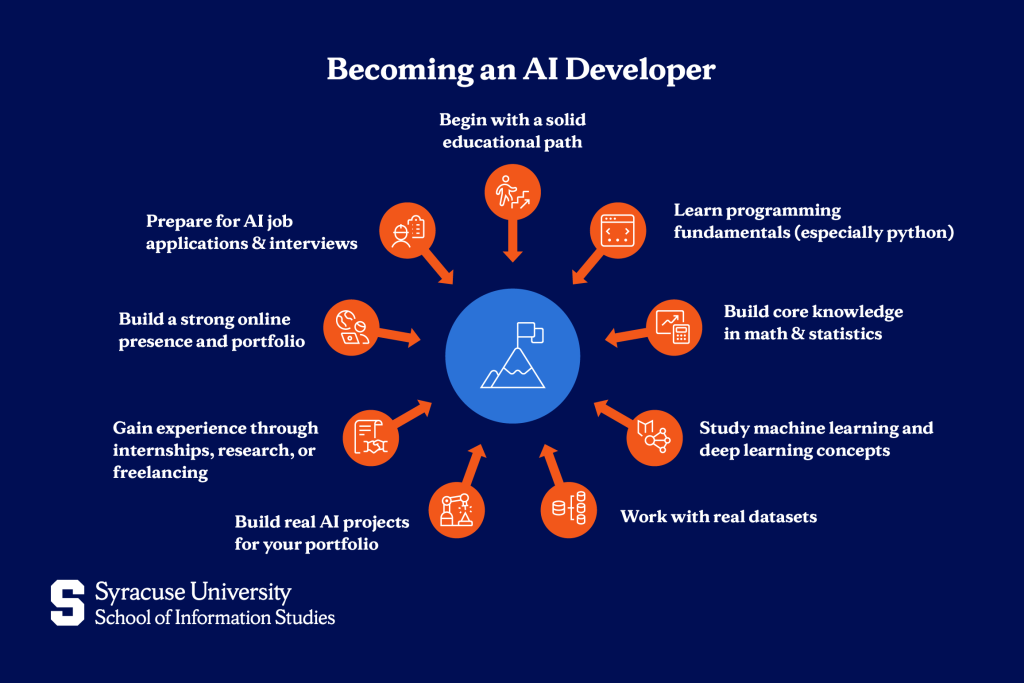
Begin with a solid educational path
Starting with structured education gives you a strong foundation in AI, programming, and problem-solving. Whether you choose a bachelor’s degree in computer science, data science, or a related field, or you’re considering graduate education, formal programs help you build skills faster with expert guidance.
One option worth exploring is the Applied Human-Centered Artificial Intelligence Master’s Degree at Syracuse University’s iSchool. This program focuses on practical AI skills, ethical AI development, and real-world applications. You’ll work on hands-on projects, learn from faculty with industry experience, and build a portfolio that demonstrates your abilities to future employers.
On the other hand, there are also many successful AI developers who are self-taught or use bootcamps. However, structured programs offer clear learning sequences, mentorship, and networking opportunities that can accelerate your progress.
Learn programming fundamentals (especially Python)
Python is the main language for AI development. It’s beginner-friendly, widely supported, and has powerful libraries specifically built for machine learning and data processing.
Start by understanding:
- Variables and data types (integers, strings, lists).
- Control structures (if statements, loops).
- Functions and modules (how to write reusable code).
- Data structures (dictionaries, arrays, sets).
- Object-oriented programming basics.
Practice through small coding exercises on platforms like LeetCode, HackerRank, or Codecademy. Build simple programs, such as calculators and to-do lists, to reinforce concepts.
While Python is essential, you may also encounter R (for statistical analysis), Java (for large-scale systems), or C++ (for performance-critical applications). Focus on Python first, then branch out as needed.
Build core knowledge in math & statistics
AI developers need to understand the mathematical concepts that drive algorithms and models. You don’t need a PhD in mathematics, but you should be comfortable with:
- Linear algebra: Vectors, matrices, and operations that form the basis of neural networks.
- Calculus basics: Derivatives and gradients, which help optimize models.
- Probability theory: Understanding how models make predictions based on uncertainty.
- Statistics: Mean, median, standard deviation, hypothesis testing, and correlation.
These concepts help you understand why models behave certain ways, how to improve performance, and how to interpret results. Online courses can also help you build this knowledge.
Study machine learning and deep learning concepts
Once you’re comfortable with programming and math, start learning how AI systems actually work.
Key machine learning concepts include:
- Supervised learning: Training models on labeled data (like image classification).
- Unsupervised learning: Finding patterns in unlabeled data (like customer segmentation).
- Neural networks: The building blocks of deep learning.
- Model evaluation: How to measure accuracy, precision, recall, and other metrics.
- Overfitting and underfitting: Common pitfalls and how to avoid them.
Understanding the difference between machine learning and deep learning is important as you progress. Deep learning uses layered neural networks to handle complex tasks like image recognition, natural language processing, and autonomous systems.
Structured programs often teach these concepts in a guided, hands-on format. For example, the Syracuse master’s program mentioned earlier includes coursework on machine learning, neural networks, and AI ethics, helping students learn faster through real projects and expert feedback.
Work with real datasets
It’s important to practice with actual data to understand how AI works in the real world. So, start by:
- Finding datasets: Use Kaggle, UCI Machine Learning Repository, or government open data portals.
- Exploring data: Look at distributions, missing values, and patterns.
- Cleaning data: Handle missing values, remove duplicates, and format inconsistencies.
- Preprocessing data: Normalize values, encode categories, and split into training/testing sets.
Real-world data is messy, incomplete, and often challenging. The more you practice data preparation, the more comfortable you’ll become with the entire AI development process.
Build real AI projects for your portfolio
Projects prove you can apply what you’ve learned. They’re also what employers look at when evaluating candidates.
Good beginner projects include:
- Sentiment analysis tool: Analyze customer reviews or social media posts to determine positive, negative, or neutral sentiment.
- Image classifier: Build a model that categorizes images (e.g., types of animals or product categories).
- Chatbot: Create a simple conversational agent using NLP techniques.
- Recommendation system: Build a system that suggests products or content based on user preferences.
- Predictive model: Forecast trends like stock prices, weather, or customer behavior.
Document each project clearly. Include:
- Problem statement.
- Data sources.
- Your approach and methods.
- Results and insights.
- Code (hosted on GitHub).
Showing your work publicly demonstrates technical skills, communication abilities, and problem-solving approaches (all qualities employers value).
Gain experience through internships, research, or freelancing
Hands-on experience accelerates your growth and builds credibility. Even without prior AI work experience, you can find opportunities to practice and learn.
Consider:
- Internships: Many companies offer AI internships for students or early-career professionals.
- Research projects: Work with professors or research labs on AI applications.
- Hackathons: Participate in AI competitions to solve problems under time constraints.
- Open-source contributions: Contribute to AI projects on GitHub
- Freelance work: Build models or analyze data for small businesses or startups.
Each of these experiences adds depth to your resume and helps you develop skills that aren’t taught in textbooks, including working with teams, managing timelines, and adapting to changing requirements.
Build a strong online presence and portfolio
Employers want to see what you’ve built. Your online presence ends up doing a lot of the talking for you: it’s your professional calling card, showing not just what you know, but how you apply it in real situations.
Create:
- A GitHub profile: Show your code, projects, and contributions.
- A personal website or portfolio: Present your work with descriptions, visuals, and results.
- Case studies: Write detailed explanations of how you approached and solved problems.
- LinkedIn posts: Share insights, projects, or lessons learned.
Keep your portfolio updated. Remove outdated projects and add new ones that reflect your growing skills. Highlight projects that show variety (for example, NLP, computer vision, data analysis) to demonstrate breadth.
Prepare for AI job applications & interviews
When you’re ready to apply, tailor your materials to each role. AI developer positions vary widely: some focus on building models, others on deploying systems, and some on research.
Prepare by:
- Customizing your resume: Highlight relevant projects, skills, and tools that match the job description.
- Writing a strong cover letter: Explain why you’re interested in AI and what you bring to the role.
- Practicing coding interviews: Review algorithms, data structures, and Python fundamentals.
- Studying ML concepts: Be ready to explain how models work, when to use different algorithms, and how to evaluate performance.
- Preparing scenario questions: Think through how you’d approach real-world AI problems.
Mock interviews with peers, mentors, or online platforms can help you refine your responses and build confidence.
How Long Does It Take to Become an AI Developer?
The timeline for becoming an AI developer varies based on several factors, including how quickly you learn, whether you study full-time or part-time, and the type of education path you choose. Structured programs can speed things up by offering clear guidance, while self-directed learning may take longer. Building projects also plays a major role since hands-on work takes time but is essential for real progress. This way:
Complete beginners (no programming experience) typically need:
- 1-2 years for foundational programming, math, and basic ML knowledge
- An additional 6-12 months to build projects and gain practical experience
People with programming backgrounds (software developers transitioning to AI) often need:
- 6-12 months to learn ML concepts, frameworks, and build AI projects
- 3-6 months of focused practice to become job-ready
Those with related degrees (computer science or data science) may need:
- 3-6 months of targeted AI training and portfolio building
Above all, consistency matters more than short bursts of intense effort. There’s no single “correct” timeline, so it’s better to focus on building real skills and showing them through projects rather than rushing to meet an arbitrary deadline.
Essential Skills Every AI Developer Needs
AI development requires a mix of technical knowledge and problem-solving ability.
Technical skills
To work effectively in this field, you need a strong foundation in programming, with Python being essential and languages like R, Java, or C++ useful for certain use cases. Familiarity with machine learning and deep learning frameworks such as TensorFlow, PyTorch, Scikit-learn, and Keras helps you build, train, and experiment with models.
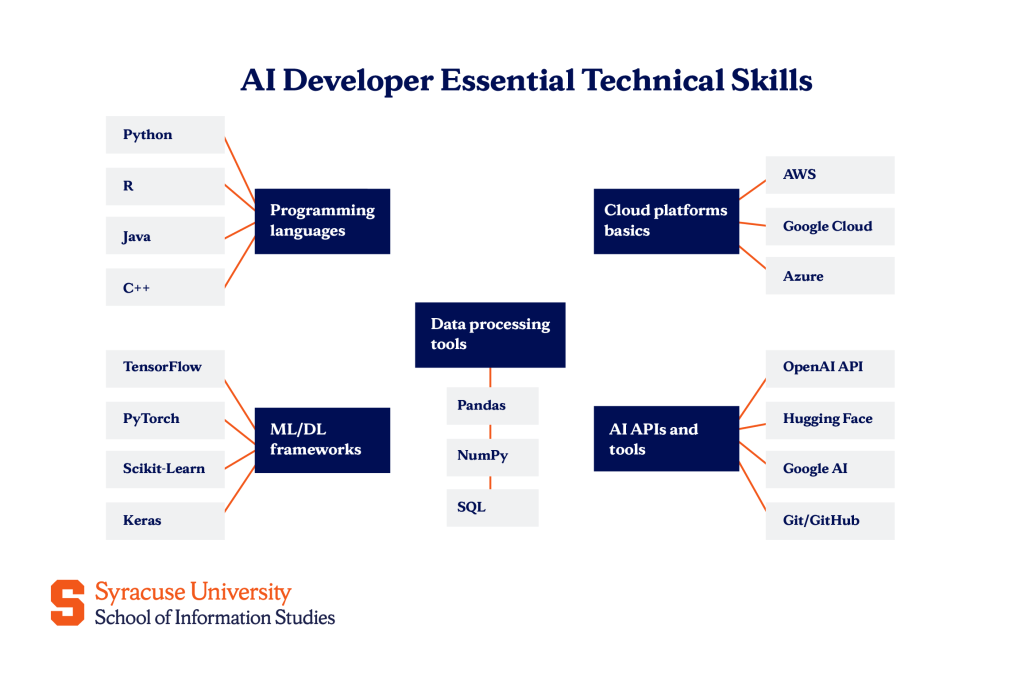
Data processing skills are equally important, including working with tools like Pandas and NumPy for analysis and SQL for querying databases. A basic understanding of cloud platforms such as AWS, Google Cloud, or Azure is also valuable, especially for deploying and scaling AI systems, along with knowing how cloud storage, compute resources, and ML services fit together. Many developers also rely on AI APIs and tools like OpenAI or Hugging Face for access to pre-trained models, while Git and GitHub are essential for version control and collaboration.
You don’t need to master all of these at once, but understanding how they work together will make you far more effective as an AI developer.
Soft skills
Technical abilities are important, but success in AI also depends on how well you work with people and approach problems. Clear communication helps you explain complex AI ideas to non-technical stakeholders, while teamwork is essential when collaborating with data scientists and product managers.
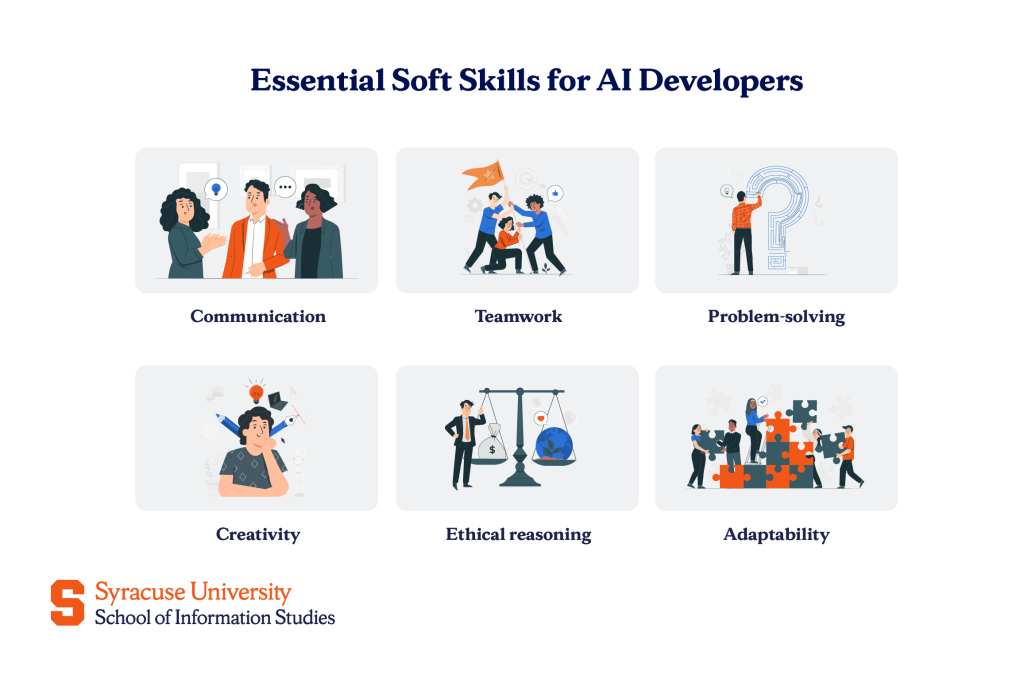
Strong problem-solving skills allow you to break large, complex challenges into manageable steps, and creativity helps you find workable solutions when standard approaches fall short. Ethical reasoning is increasingly critical, as it helps you understand both the benefits of AI and the risks related to bias, fairness, and real-world impact. Adaptability matters as well, since AI tools and techniques change quickly.
These skills show up in every AI project, from spotting and reducing bias in a hiring model to clearly explaining results and recommendations to leadership.
Careers, Job Roles & AI Developer Salary
AI development opens doors to diverse career paths. Understanding the roles and salary expectations helps you set realistic goals.
Common AI developer job roles include:
- AI Developer / Machine Learning Specialist
Designs, builds, and deploys machine learning models. Works with data pipelines, model training, and production systems. - NLP Specialist
Focuses on natural language processing, building chatbots, language models, sentiment analysis tools, and text generation systems. - Computer Vision Developer
Develops systems that interpret visual information: facial recognition, object detection, medical imaging analysis, and autonomous vehicle perception. - AI Researcher
Explores new algorithms, techniques, and applications. Often works in academic settings, research labs, or advanced R&D teams. - AI Solutions Specialist
Bridges the gap between AI capabilities and business needs. Designs AI systems that solve specific problems for clients or internal teams.
Each role requires similar foundational skills but emphasizes different applications. As you gain experience, you may specialize in one area or move between roles depending on your interests.
AI developer salary overview
AI developer salaries are competitive, reflecting high demand and specialized skills. Annual earnings usually range from $106,000 to $150,000, with top earners surpassing $158,000.
Several factors influence how much an AI developer earns, starting with experience, specialization, and industry. More years in the field and a strong record of successful projects usually lead to higher pay. Tech, finance, and healthcare typically pay more than education or nonprofit sectors. Education can affect compensation, as advanced degrees, such as a master’s or a PhD, may raise starting salaries.
Location is another factor, with higher pay often offered in areas with a higher cost of living. Additionally, portfolio strength is critical, as employers place a high value on proven projects and real results, sometimes more than formal credentials.
Overall, AI salaries tend to exceed those of general software development roles due to the specialized expertise required, and compensation continues to rise as organizations place greater value on AI-driven work.
Is AI Development a Good Career?
AI development is a good career choice since it offers strong career prospects, intellectual challenges, and the opportunity to work on technology that shapes the future.
- Job stability: There is a high demand for AI developers and nearly every industry, from healthcare to retail to entertainment, is investing in AI systems.
- Future relevance: AI is becoming a core technology in business operations, customer experiences, and product development. Learning AI now positions you for long-term career stability.
- Industry diversification: You’re not limited to tech companies. AI developers work in finance (fraud detection), healthcare (diagnostics), manufacturing (automation), marketing (personalization), government (cybersecurity), and more.
- Rapid growth: All types of AI continue expanding, from generative models to reinforcement learning to ethical AI frameworks. This growth creates new roles and opportunities.
- Human-centered focus: As AI becomes more powerful, the need for human-centered AI training increases. Programs that teach responsible, ethical AI development prepare you to build systems that benefit people rather than harm them.
AI development is challenging. You’ll need to stay current with new tools, techniques, and research. But if you enjoy problem-solving, continuous learning, and building systems that make a real impact, AI development is a rewarding career path.
Your AI Career Starts Now
Becoming an AI developer is achievable with the right approach. Start by learning Python, building a solid understanding of machine learning concepts, and working on real projects that showcase your skills.
If you’re looking for a structured path with expert guidance, consider exploring the Applied Human-Centered Artificial Intelligence Master’s Degree at Syracuse University’s iSchool. This program combines technical training with ethical AI frameworks, real-world projects, and career preparation, helping you build the skills employers are hiring for right now.
The best time to start is today. Pick one step (learn Python basics, build your first project, or research educational programs) and take action. Your AI career begins with that first decision!
Frequently Asked Questions (FAQs)
Do I need cloud computing experience for AI roles?
Not right away, but it helps. Many AI systems are deployed on cloud platforms like AWS, Google Cloud, or Azure. Basic familiarity with cloud storage, compute instances, and ML services can make you a more competitive candidate.
Can I become an AI developer without a technical background?
Yes, but expect a longer learning curve. You’ll need to start with programming fundamentals before moving into AI-specific concepts. Many successful AI developers come from non-technical backgrounds, such as teachers, business analysts, or designers, and transition successfully through self-study or structured programs. Focus on building a strong foundation before tackling advanced topics.
What are good beginner-friendly AI projects?
Start with simple, well-defined problems: spam email classifiers, house price predictors, movie recommendation systems, or handwritten digit recognition. These projects teach you data preprocessing, model training, and evaluation without overwhelming complexity. As you gain confidence, move to more challenging projects like chatbots or image classifiers.
Is math absolutely required for AI development?
Yes, but you don’t need advanced mathematics right away. Understanding linear algebra, basic calculus, probability, and statistics is essential for building and optimizing AI models. Many developers learn math alongside programming rather than mastering it first. Online courses and textbooks can help you build mathematical intuition as you work on projects.
Should I specialize early in a field like NLP or computer vision?
Start by learning general machine learning concepts and building diverse projects. Specializing too early can limit your understanding of AI’s broader applications. Once you have a solid foundation, explore different areas through projects and coursework. You’ll naturally gravitate toward what interests you most; then you can specialize.