
Key Takeaways
- Information science focuses on how people create, organize, and use information, not just how systems are built.
- The field offers high-paying roles across data, UX, governance, security, and systems design.
- Information science differs from computer science and data science by prioritizing usability, structure, and access over coding or prediction.
- Early career success depends on practical experience, portfolios, and foundational skills that support specialization over time.
Students who are drawn to both technology and people-centered work often find themselves unsure where they fit. Traditional academic paths tend to separate technical disciplines from fields focused on communication, ethics, and human behavior, even though modern organizations rely on all of these elements working together.
Information science sits at the intersection of these areas. Its emphasis is on making systems usable, data meaningful, and digital environments functional for those who depend on them.
This guide explores some of the highest-paying roles within information science, what early career work in the field typically looks like, and which skills remain valuable as automation and artificial intelligence continue to reshape the workforce.
What is Information Science?
Information science is an interdisciplinary field that looks at how people create, organize, find, and use information. It pulls ideas from library science, namely how knowledge is categorized and retrieved, along with cognitive psychology, which looks at how humans process information, as well as computer science, which focuses on how technology stores and delivers data.
It’s also helpful to be clear about what information science is not. It isn’t a lighter or simplified version of computer science. While computer science majors often spend their time writing algorithms or fine-tuning code performance, information science focuses more on user experience, information architecture, and making sure systems actually work for real people, not just in theory.
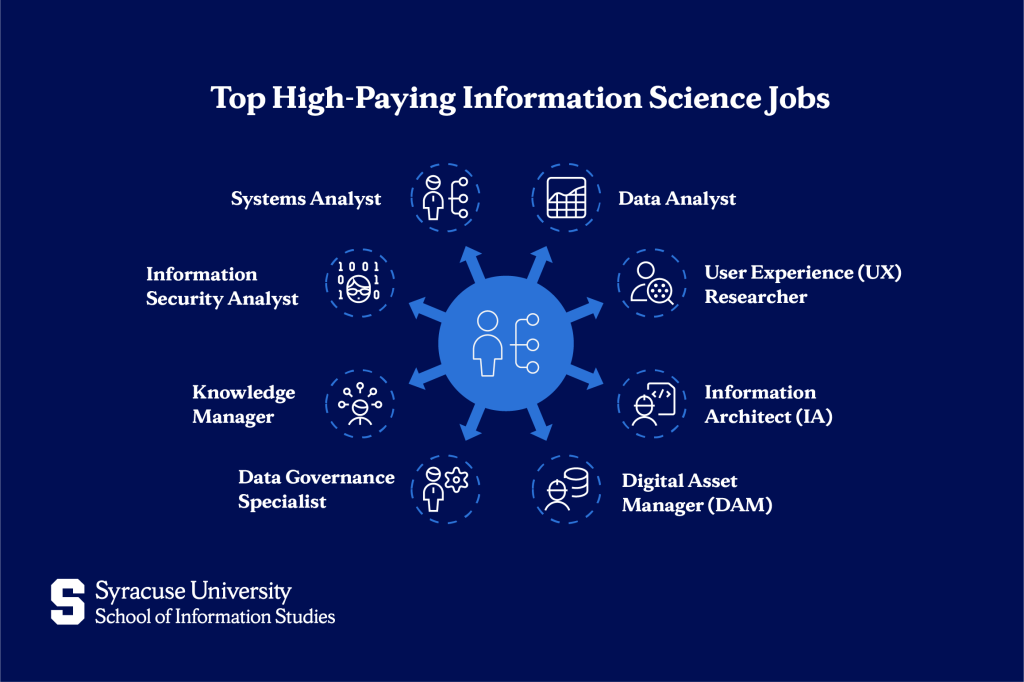
Top 8 High-Paying Information Science Jobs
Information science offers various career opportunities across industries. Among them are the following roles known for high salaries and long-term career growth.
Data Analyst
Average annual salary: $82,640
Data analysts use numbers to answer practical business questions and support better decision-making. A lot of their work starts with spotting patterns in raw data and figuring out what those patterns actually mean—like why customers leave a website before finishing a purchase or which marketing campaigns are really pulling their weight.
Before any insights show up, though, a big chunk of time goes into preparing the data itself. That means cleaning up messy spreadsheets, dealing with missing values, and standardizing formats so everything lines up correctly. Once the data is reliable, analysts use tools like SQL to query databases, visualization platforms such as Tableau or Power BI to share findings, and Excel for quick, exploratory work. Python is used more and more to automate repetitive tasks and make workflows run a little smoother.
User Experience (UX) Researcher
Average annual salary: $113,102
UX researchers focus on understanding how people interact with digital products—and why certain designs work while others fall flat. Their job is to uncover user needs, frustrations, and behaviors using research methods like usability testing, interviews, and behavioral analysis.
A large part of the role is acting as the user’s advocate during product development. UX researchers analyze test results, turn those findings into clear recommendations, and present evidence that design and product teams can actually use. Common tools include platforms like UserTesting for remote studies, Figma for reviewing prototypes, survey tools such as Qualtrics, and qualitative analysis software like Dovetail to organize and interpret insights.
Information Architect
Average annual salary: $132,080
Information architects design the underlying structure of websites and applications so users can find what they need without getting lost or frustrated. Their focus is on organizing content in a logical way through navigation systems, taxonomies, and overall site structure.
Day to day, this often means mapping relationships between pieces of content, running user research activities like card sorting, and creating wireframes that show how information should be grouped and accessed. Tools such as Axure and OmniGraffle are used for structural design, Miro supports collaborative workshops, and Optimal Workshop helps test navigation choices with real users.
Digital Asset Manager
Average annual salary: $95,700
Digital asset managers are responsible for large collections of digital content—images, videos, brand files, and documents—and making sure those assets stay organized and easy to find. Their work helps teams use content consistently across departments and locations.
Most of the role centers on setting metadata standards, managing permissions, and training teams on how to store and retrieve files the right way. Digital asset managers typically work with platforms like Adobe Experience Manager, Bynder, or Canto, along with cloud storage systems and content delivery tools that keep libraries accessible and up to date.
Data Governance Specialist
Average annual salary: $113,939
Data governance specialists create and enforce rules for how data is collected, accessed, and used within an organization. Their work supports regulatory compliance, protects sensitive information, and helps maintain data quality across teams.
On a typical day, they may review data practices, write or update governance policies, conduct audits, and work directly with departments to improve how data is handled. The role requires close collaboration with legal, IT, and business units, as well as the ability to translate complex regulations into clear, practical guidelines people can actually follow.
Knowledge Manager
Average annual salary: $86,119
Knowledge managers focus on capturing and organizing institutional knowledge so it doesn’t disappear when employees change roles or leave an organization. Their work supports efficiency, consistency, and collaboration by making sure important information stays accessible.
Daily responsibilities often include interviewing subject-matter experts, creating documentation, maintaining internal knowledge bases, and encouraging teams to keep content current. Tools like Confluence, SharePoint, and Notion are commonly used, along with search and collaboration platforms that help employees find reliable information quickly.
Information Security Analyst
Average annual salary: $96,652
Information security analysts help protect organizations from data breaches, misuse, and internal security risks. Unlike highly technical security engineering roles, this position puts a strong emphasis on policy, risk assessment, and human behavior.
Much of the work involves reviewing access controls, monitoring activity logs, developing response plans, and training employees to recognize threats such as phishing. Analysts also take part in incident investigations and compliance reviews, balancing technical knowledge with clear communication and strong documentation skills.
Systems Analyst
Average annual salary: $89,296
Systems analysts serve as the bridge between business teams and technical teams, making sure systems actually meet organizational needs. They focus on gathering requirements, documenting workflows, and clarifying expectations before development begins.
A typical day might include interviewing stakeholders, mapping processes, writing specifications, and coordinating across departments to keep priorities aligned. Systems analysts rely on diagramming tools, documentation platforms, and modeling techniques to translate business needs into technical direction—while keeping timelines and constraints in mind.
Information Science vs. Computer Science vs. Data Science
Information science, computer science, and data science overlap significantly. This can be confusing for students looking to choose a career in one of the three.
| Aspect | Computer Science | Data Science | Information Science |
|---|---|---|---|
| Primary focus | Building systems and software | Predicting trends using statistical models | Organizing and accessing knowledge |
| Core skills | Programming, algorithms, system architecture | Statistics, machine learning, data modeling | Information architecture, user research, metadata |
| Math intensity | Moderate to high (discrete math, algorithms) | High (statistics, linear algebra, calculus) | Low to moderate (basic statistics, logic) |
| Typical projects | Developing applications, optimizing code, building databases | Creating predictive models, experiments, running patterns, analyzing | Designing search systems, improving user flows, managing content |
| Career example | Software engineer building a mobile app | Data scientist predicting customer churn | UX researcher testing how users navigate that app |
Strategies for Landing Your First Information Science Role
Many graduates start out in IT support or help desk roles. These positions offer real exposure to systems, users, and how organizations actually function day to day. That experience can be valuable. At the same time, these roles don’t always line up with longer-term goals in areas like data analysis, UX, or information architecture. Starting here can make sense, but it’s important to notice whether a role is helping you build toward something specific or whether it’s quietly becoming a holding pattern.
One of the most effective ways to move straight into a more specialized role is through internships while you’re still in school. Internships in fields like data analysis, UX research, or information architecture give students relevant, hands-on experience early. They also reduce the chance of being funneled into general support roles after graduation simply because that’s what’s available.
For roles that focus on design and structure, such as UX research or information architecture, a degree by itself is rarely enough. Employers want to see how you think and how you work through real problems. A strong portfolio matters. Case studies that show your research process, decision-making, and outcomes often carry more weight than a long list of courses on a résumé.
Essential Skills & Certifications
While job titles vary, most roles rely on a shared mix of technical abilities, human-centered skills, and targeted credentials. Building these areas together helps you stay flexible early on while giving you room to specialize as your career develops.
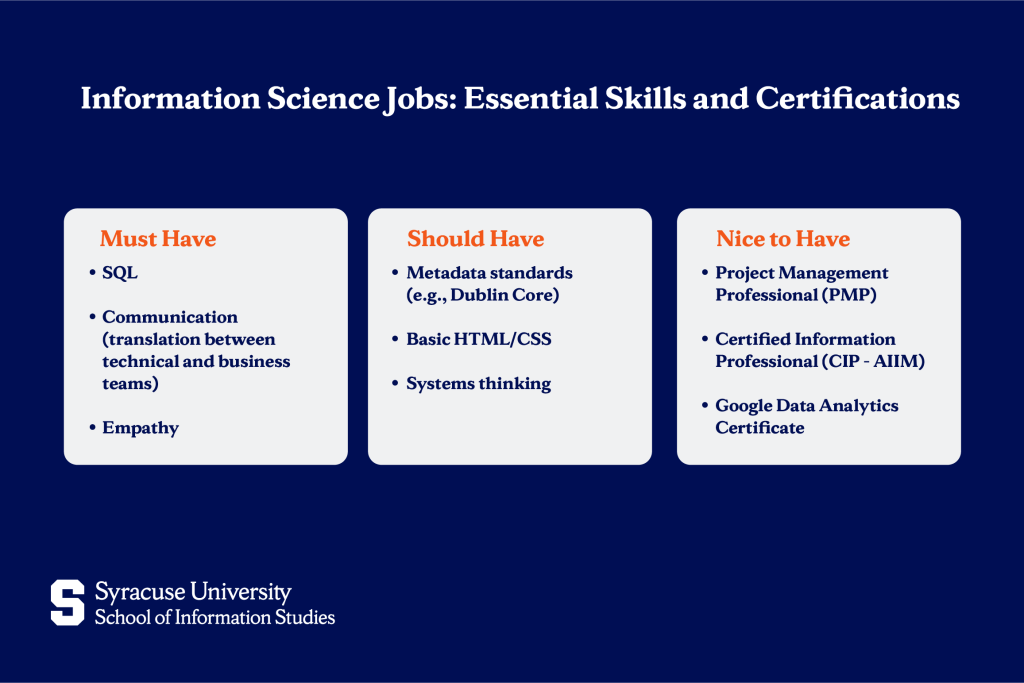
On the technical side, a few core skills show up again and again across the field:
- Writing SQL queries to retrieve, filter, and combine data from databases
- Understanding metadata standards like Dublin Core to organize and describe digital resources
- Having basic HTML and CSS knowledge to understand how digital content is structured and displayed
These tools make it possible to work directly with information rather than relying on others to interpret it for you.
Just as important are the skills that shape how information is used by real people:
- Translating technical concepts into clear language for non-technical teams
- Understanding how different users search for, interpret, and interact with information
- Thinking in systems, so changes in navigation, policy, or structure don’t create problems elsewhere
These abilities are often what separate effective information professionals from those who only know the tools.
Certifications can also strengthen your profile, especially when they align with your role or long-term goals:
- Project Management Professional (PMP) for managing complex projects and stakeholders
- Certified Information Professional (CIP) for broad information management knowledge
- Google Data Analytics Certificate as an accessible signal of data skills for early-career roles
- More specialized certifications in areas like UX, security, or governance as your focus sharpens
Rather than collecting credentials all at once, many professionals start with foundational skills and add certifications gradually as their direction becomes clearer and their responsibilities grow.
Conclusion
Information science is one of the most future-proof career paths available. While AI can generate data and even write code, humans are still needed to organize it, verify it, govern it, and make sure it actually serves people’s needs.
For individuals interested in advancing the field itself—through research, teaching, or shaping how information systems are designed and governed at a higher level—doctoral study can be a meaningful path. Syracuse University’s iSchool Ph.D. in Information Science and Technology approaches digital and information systems through a human-centered lens, treating information as a manageable resource with social and organizational dimensions. The program supports advanced research and interdisciplinary inquiry for those who want to contribute to knowledge creation, leadership, and innovation within academia or information-driven industries.
Frequently Asked Questions
Is Information Science a good career?
Yes, especially if you value variety and problem-solving. The field offers high job satisfaction because you see direct impact through better search results, clearer website navigation, and more secure data practices. Salaries are competitive, and demand continues growing as organizations recognize that managing information well creates competitive advantages.
Does Information Science require coding?
Not as much as software engineering or even data science. Basic SQL is essential, and some Python helps with automation, but you won’t spend your days debugging algorithms or building applications. The coding you do is practical—querying databases, manipulating data, automating repetitive tasks. If you can handle spreadsheet formulas, you can handle information science programming.
Can you work remotely with an Information Science degree?
Absolutely. Data analysis, UX research (especially remote user testing), and digital asset management adapt well to distributed work. Some roles, like systems analyst, may require occasional on-site time for stakeholder meetings, but hybrid and fully remote positions are common, especially at tech companies and organizations with distributed teams.
Do I need a Master’s degree (MLIS)?
Only for specific roles. Academic or public librarians usually need a Master of Library and Information Science. Archivists at cultural institutions often require it. But corporate tech roles typically accept bachelor’s degrees, especially with relevant experience or a Ph.D. in Information Science and Technology for research and academic positions. A master’s helps with career advancement, but isn’t required to start.