
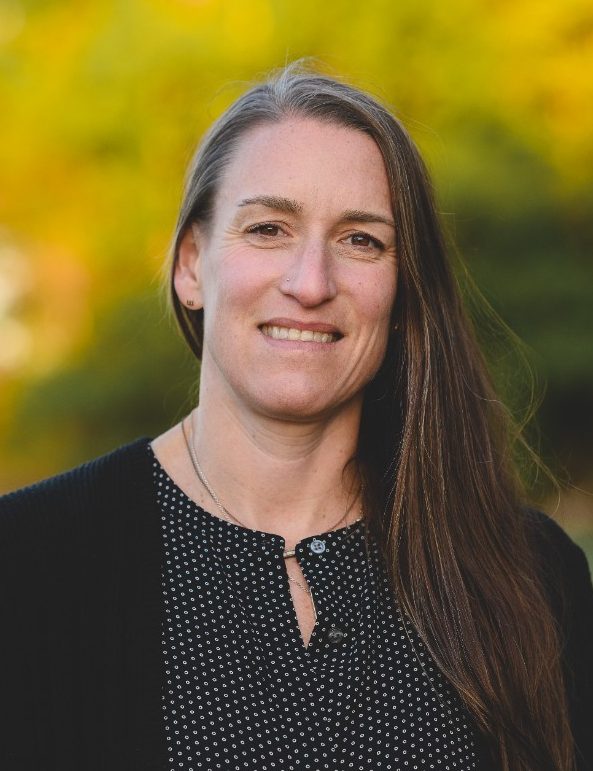
 When Erin Knight, DPS ’27, returned from maternity leave to her corporate job in 2023, she found herself looking at her calendar with new eyes.
“Is it worth me handing my child off to someone else so I can go to work and attend this meeting?” she recalled. “It made me hyper-aware. Why are we meeting? What are we trying to get done?”
After more than 25 years working in product management, user experience, and technology, Knight was used to identifying inefficiencies. But this moment—paired with the meeting-heavy culture intensified by the COVID-19 pandemic—brought one problem sharply into focus. Meetings, she realized, were often poorly designed for the humans in them.
That insight now sits at the center of Knight’s work as both an entrepreneur building meeting-design startup Gatherwise and a student in the iSchool’s doctor of professional studies program in information management.
“I’m driven by recognizing, understanding human problems and then trying to use technology to solve them,” she said. “Meetings are meaningful to me because I’ve lived it.”
Knight grew up in Maine and “accidentally” began working in tech in 2000, shortly after graduating from Colby College with a degree in psychology. Her first job was with a direct mail company outside of New York City. “A week in, they walked me across to another building and said, ‘we want to introduce you to our new tech department,’” she said. “And so I kind of fell into it, working with companies doing early e-commerce.”
She later joined a Boston-based company acquired by Blackboard, one of the early learning management system providers. But the lack of attention to user experience left her disillusioned. “CIOs were buying it, but literally everyone actually using it was frustrated with it,” she said, referring to reactions from faculty and students.
Looking for people who prioritized understanding humans before designing for them, Knight found her way to the University of California, where she earned a masters degree in information management and systems in 2010. “I’m a serial iSchooler,” she laughed.
As online learning expanded, Knight became a key advocate for digital credentials, an idea that was taken up by Mozilla. She went on to lead the development of Open Badges, an early credentialing infrastructure. What began with 1,000 badges during the first year grew to tens of millions issued annually, bringing her national recognition and invitations to work on entrepreneurial projects with venture capitalists. But life took a different turn.
In 2015, Knight’s husband passed away suddenly, leaving her to raise two young children in Maine. She joined WEX, where she spent seven years rising rapidly through the organization—from updating websites to head of product of the fleet division and leading an internal startup—but corporate culture never felt like a long-term fit. “I felt that pull back into entrepreneurship,” she said.
That pull became undeniable after returning from maternity leave with her third child with her second husband. Her experience navigating meeting-heavy, committee-driven environments directly inspired Gatherwise, the startup she founded in 2024.
Gatherwise offers evidence-based meeting facilitation designed to ensure meetings have a clear purpose and real-time support. “This is a human choreography problem,” Knight said. “I wanted to build from what’s already known about human dynamics and make that the differentiator.”
That desire led her to the Syracuse iSchool. “I was excited to find that meeting science already existed,” she said. Through the DPS program, Knight is deepening her research while bridging the gap between academic knowledge and everyday workplace practice.
Now in the seed stage, Gatherwise has a team of five and about 100 customers, and it has raised $250,000. The company was recently accepted into the Founder Residency program at Northeastern University’s Roux Institute.
Looking ahead, Knight plans to continue blending research, entrepreneurship, and leadership. “I love zero to one,” she said. “But I also love building teams and culture and working with empowered people to figure things out together.”
Through her work, she hopes meetings will be more intentional—so participants no longer have to wonder whether their time is being spent well.