
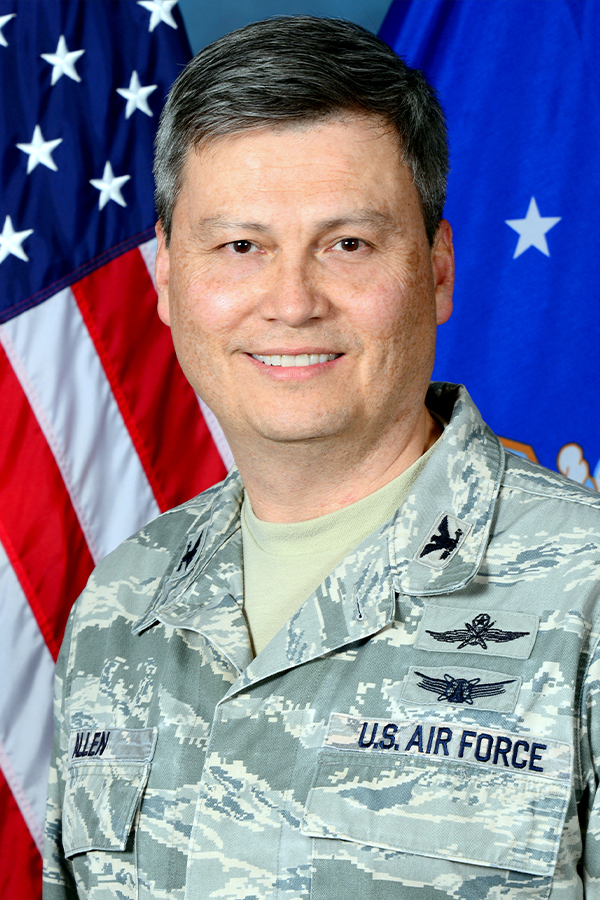
 Charles “Chuck” Allen, M.S. ’25, believes that if IT had a mascot, it should be a shark.
“To survive, a shark has to keep moving forward” he said. “If it gets complacent, it will eventually lose momentum and die. Similarly in IT, we have to keep moving forward and evolve in the same way, because if you lose momentum you lose relevance.”
That is a major lesson Allen reinforced during his years earning a degree in information management (information security) at Syracuse—one he applied in a nearly four-decade career in technology.
Eager to serve his country, the native of El Paso, Texas, embarked on this path by joining the military in 1988 after completing a bachelor’s degree in computer science at the University of Texas in his hometown. Allen chose the Air Force because it offered him a scholarship and opportunities to pursue his deep interest in technology. “The Air Force is very tech savvy—aircraft are really just flying computers with wings,” he explained.
A decade and a half in, Allen had already amassed numerous cyber leadership roles, recognitions—and two master’s degrees, one from the University of Oklahoma in 1997 and Air Command and Staff College in 2002.
Always expanding his skill set, he decided to enroll in Syracuse University’s hybrid program, supported by a Department of Defense (DoD) Information Assurance scholarship. “I was impressed with the challenging curriculum; it was very hands-on, and I learn better that way,” he said.
Instead of focusing on specific tools or products, which keep changing over the years, he explained, his professors—informed by their own industry experience and research projects—placed emphasis on strategy. “I call that approach ‘kinetic,’” he said. “You move forward instead of being passive. Tools and platforms will often change with time, but the strategy is like the North Star, constantly guiding us to our objectives.”
Returning to the Air Force after graduation, Allen applied his newly acquired expertise and perspective to projects for the DoD’s IT shop with a global footprint, the Defense Information Systems Agency (DISA). “I was able to influence cybersecurity decisions across the entire DoD,” he said.”Syracuse provided me with a strong strategic foundation to lead change with confidence during turbulent times. It gave me the skills to anticipate risk, align technologies with objectives, and drive organizations’ technology transformation.”
Allen made a name for himself by significantly streamlining internal and external personnel, project, and accounting processes—frequently ahead of schedule, under budget, and across multiple organizations. Among his accomplishments are slashing DISA information assurance vulnerabilities from 33,000 cases to zero in 18 months while he served as DISA Information Assurance Division Chief. He also led a team to leverage virtualization and quick prototyping on the National Cyber Range—compressing cyber threat analysis for the Space Mission System components from 9 to 3 months and saving half a million dollars in costs.
When Allen retired from his most recent position as commander of DISA’s Northern Field Command in 2014, he did so as a colonel, a high rank for someone working in technology within the military. But perhaps this is not surprising in light of the long list of awards and recognitions he garnered for his work along the way, setting examples of leadership and teamwork that have served as models for other DoD organizations.
Allen went on to serve as director of the Cyber Ops and Resilience Department for the Aerospace Corporation—a non-profit with a highly skilled workforce behind such innovations as GPS—for another decade before fully retiring last year.
While taking care of his aging mother in Colorado, Allen is, of course, not standing still. He mentors students, volunteers serving meals to the homeless, and works with a center that helps veterans transition into civilian life. He’s also auditing classes at a local university.
“Right now I’m studying quantum mechanics, and it’s tough,” Allen said. “But struggling with a difficult problem also brings satisfaction when you meet the challenge head on. You need continuous advancement for survival and relevance, lock in on the path ahead.”