
Key Takeaways
- Responsible AI promotes fairness, transparency, and accountability in decision-making systems.
- Organizations can use frameworks like the OECD Principles and NIST AI Framework for guidance on responsible AI.
- Implementing responsible AI involves training teams, auditing systems, and maintaining human oversight.
AI is changing how and where we work, learn, and solve problems. From individualized learning platforms to automatic admissions systems, AI now reaches into nearly every corner of higher education and industry.
But with this power comes serious responsibility. When AI systems decide who will gain admission to college, recommend career paths, or analyze research data, those decisions must be fair, explainable, and trustworthy. A biased algorithm could deny opportunities to qualified students. An opaque system could make life-changing decisions without anyone understanding why.
That’s why responsible AI matters. It’s about more than creating smarter tools; it’s about creating systems that are fair, accountable, and worthy of trust.
What Responsible AI Is and Why It Matters Today
Responsible AI refers to the practice of designing, developing, and using artificial intelligence in ways that are ethical, fair, transparent, and accountable. It’s about making sure AI systems respect human rights, operate within legal boundaries, and align with societal values.
Think of it as a framework that guides how we build AI to be trustworthy and beneficial for everyone it affects.
Why does this matter right now? Because AI is making decisions that used to require human judgment. Universities use AI to sort through thousands of applications. Healthcare systems use it to recommend treatments. Companies use it to screen job candidates.
When these systems work well, they can process information faster and more consistently than humans ever could. But when they fail, through bias, errors, or lack of transparency, the consequences can be severe. A hiring algorithm trained on historical data might perpetuate gender discrimination. A generative AI tool could spread misinformation that damages reputations or misleads students.
The stakes are real. That’s why building responsible AI is essential for maintaining trust and ensuring technology serves everyone fairly.
Key Principles of Responsible AI
Building responsible AI requires following core principles that protect people and uphold trust. Here are the foundations that matter most.
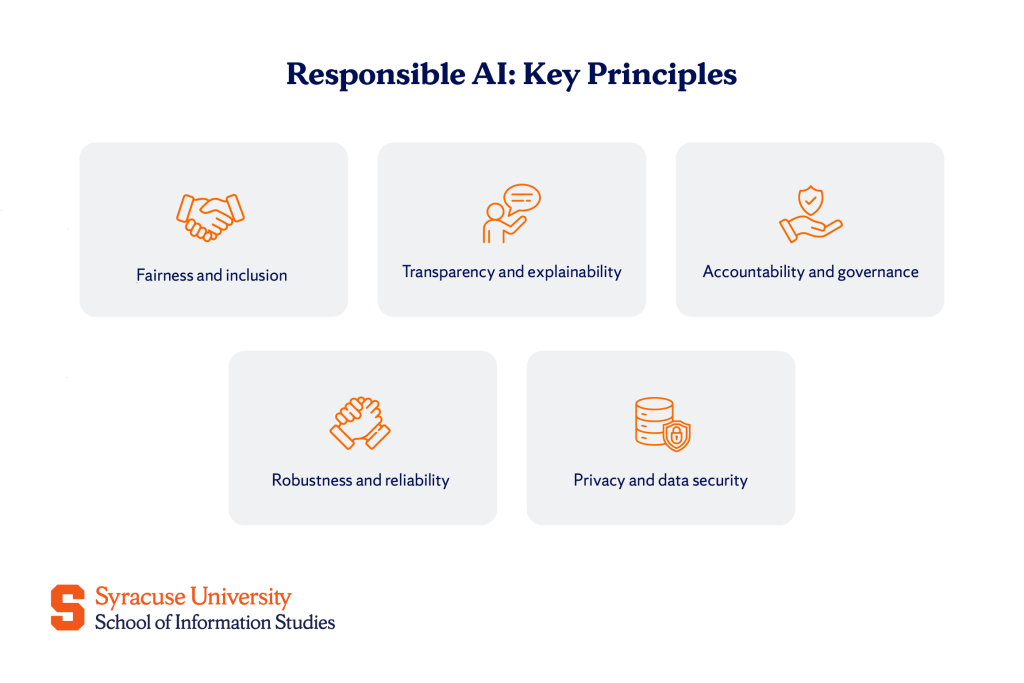
Fairness and inclusion
AI systems should treat everyone equitably, regardless of race, gender, age, or background. This means actively working to eliminate bias from both the data that trains these systems and the algorithms that make decisions.
Algorithmic bias happens when AI learns from data that reflects historical inequalities. For example, if a hiring system learns from decades of applications where most senior positions went to one demographic, it might wrongly conclude that candidates from other backgrounds are less qualified.
Organizations can address this by using diverse, representative datasets and regularly testing for bias across different groups. At Syracuse University’s iSchool, students learn to audit algorithms for fairness; an increasingly vital skill as more companies recognize the ethical and legal consequences of biased AI.
Transparency and explainability
People deserve to know when AI is making decisions about their lives, and they deserve to understand how those decisions are made.
Transparency means being upfront about when AI is in use. Explainability goes further: it means AI systems should be able to show their reasoning in ways that people can understand. This is especially critical in high-stakes situations like college admissions, medical diagnoses, or criminal justice.
Explainable AI (XAI) techniques help break down complex machine learning models into understandable components. Instead of treating AI as a “black box,” these approaches reveal which factors influenced a decision and how much weight each factor carried.
This builds trust. When students understand how an AI tutoring system identifies their learning gaps, they’re more likely to engage with it. When faculty see how an AI tool recommends research collaborations, they can verify the logic and add their own judgment.
Transparency also supports compliance. Regulations like the EU’s AI Act increasingly require organizations to document and explain their AI systems. Building explainability from the start makes meeting these requirements much easier.
Accountability and governance
When AI makes a mistake, someone needs to be responsible for fixing it and preventing it from happening again. That’s where accountability comes in.
Responsible AI requires clear governance structures. Organizations need to designate who oversees AI systems, who reviews their decisions, and who responds when problems arise. Many companies now establish AI ethics boards, which are cross-functional teams that review proposed AI projects before they launch.
These boards ask questions like: Does this system align with our values? Could it cause harm? Are we prepared to explain how it works if regulators or affected people ask?
Accountability also means creating audit trails. AI systems should log their decisions and the data they used to make them. This makes it possible to investigate errors, identify patterns of bias, and improve the system over time.
For students interested in AI governance, this represents a growing career field. Organizations need people who can bridge technology, ethics, and policy—exactly the kind of interdisciplinary thinking that Syracuse iSchool emphasizes.
Robustness and reliability
AI systems need to perform consistently and securely, even when facing unexpected inputs or adversarial attacks.
Robustness means the system doesn’t break or produce nonsense results when it encounters data slightly different from what it was trained on. A robust AI admissions tool should still function properly if an application is missing a field or contains an unusual format.
Reliability means the system produces accurate, consistent results over time. It doesn’t suddenly change its behavior or degrade in quality without explanation.
Security is also critical. AI systems can be vulnerable to attacks that trick them into making wrong decisions. For example, adding tiny, invisible changes to images can fool computer vision systems. In sensitive applications like cybersecurity or autonomous systems, these vulnerabilities could have serious consequences.
Building robust AI requires rigorous testing across diverse scenarios, continuous monitoring in real-world use, and security measures that protect against both accidental errors and intentional attacks.
Privacy and data security
Responsible AI protects people’s personal information at every stage, from data collection through storage and use.
This starts with data minimization: only collecting the information you actually need. If an AI tutoring system can work effectively with anonymized student data, there’s no reason to store identifiable information.
When systems do handle personal data, they need strong protection measures. This includes encryption, access controls, and secure storage practices. It also means getting meaningful consent; making sure people understand what data you’re collecting and how you’ll use it.
Privacy considerations extend to AI outputs, too. Generative AI systems trained on large datasets could potentially expose private information from their training data. Responsible developers test for these risks and implement safeguards to prevent leakage.
Frameworks and Guidelines for Responsible AI
Organizations don’t have to build responsible AI practices from scratch. Several established frameworks provide structure and guidance.
The OECD AI Principles (2019) set international standards emphasizing inclusive growth, sustainable development, human-centered values, transparency, and accountability. These principles have been adopted by over 40 countries and influence policy worldwide.
In the United States, the NIST AI Risk Management Framework (2023) offers voluntary guidance for managing AI risks. It’s organized around four functions: govern, map, measure, and manage. Organizations can use it to identify risks, assess their systems, and implement appropriate controls.
The EU AI Act, which began enforcement in 2024, takes a risk-based approach. It classifies AI systems by risk level and imposes stricter requirements on high-risk applications like hiring tools or credit scoring systems. This represents the world’s first comprehensive AI regulation and sets a precedent other regions are likely to follow.
Implementing these frameworks internally typically follows a three-step model:
- Assess: Review your current AI systems and practices against framework requirements.
- Implement: Establish policies, processes, and controls to meet standards.
- Audit: Regularly review and test your systems to ensure ongoing compliance.
These frameworks represent collective wisdom about what makes AI trustworthy and beneficial. Organizations that adopt them early gain competitive advantages in markets where trust and ethics increasingly influence buying decisions.
Implementing Responsible AI in Practice
Moving from principles to practice requires concrete steps. Here’s how organizations can embed responsible AI into their operations:
- Define internal principles aligned with your mission. For instance, Syracuse University’s values around diversity, accessibility, and academic excellence should shape how its AI systems work. Your organization’s principles should reflect what matters to your stakeholders.
- Establish clear governance structures. Designate who oversees AI projects, who reviews them for ethical concerns, and who makes final decisions about deployment. Create channels for reporting problems and resolving ethical dilemmas.
- Train your teams on ethical AI practices. Everyone involved in building or using AI (from data scientists to project managers) needs to understand responsible AI principles and how to apply them in their daily work.
- Build ethical checks into every stage of development. This includes bias testing during development, human review before deployment, and ongoing monitoring after launch. Don’t wait until a system is finished to think about fairness or privacy.
- Maintain human oversight for high-stakes decisions. AI can inform decisions, but when those decisions significantly affect people’s lives, like admissions, hiring, or healthcare, keep humans in the loop who can apply judgment, context, and empathy.
- Share knowledge and collaborate across industries. Responsible AI is a field where collective learning benefits everyone. Participate in working groups, share best practices, and learn from others’ successes and mistakes.
Real-World Examples of Responsible AI
Seeing responsible AI in action makes these principles concrete.
Microsoft and Google have both published comprehensive responsible AI frameworks that guide their product development. These frameworks include regular bias audits, transparency reports, and ethics review boards that evaluate new AI features before launch. When issues arise, these companies’ documented processes help them respond quickly and systematically.
Healthcare AI offers powerful examples of transparency in practice. Several hospital systems now use AI to help diagnose conditions from medical images. The most trusted systems don’t just provide a diagnosis, but they also highlight which features in the image led to that conclusion. This allows doctors to verify the AI’s reasoning and combine it with their clinical judgment. The result is better care and higher trust from both physicians and patients.
Financial institutions are increasingly adopting responsible AI for lending decisions. Rather than using opaque algorithms that might perpetuate historical bias, leading banks now use explainable models that can show applicants which factors influenced their credit decisions. This transparency helps people understand denials, improves fairness, and reduces regulatory risk.
These examples share common threads: they prioritize transparency, build in regular audits, maintain human oversight, and treat responsible AI as an ongoing practice rather than a one-time achievement.
Challenges in Achieving Responsible AI
Despite growing awareness and available frameworks, implementing responsible AI remains difficult. Here are the main obstacles:
- Data quality and bias issues: Creating fair AI requires diverse, representative training data. But most organizations’ historical data reflects past biases and inequalities. A hiring AI trained on decades of applications might have learned to favor certain demographics simply because that’s what the data showed. Fixing this requires not just technical solutions but also a critical examination of what “fair” means in context.
- Lack of standardization: Different countries and industries have different rules about AI. What’s acceptable in one market might violate regulations in another. This fragmentation makes it hard for organizations to develop consistent global AI practices. The EU’s AI Act, while comprehensive, differs significantly from emerging U.S. approaches, leaving companies to navigate conflicting requirements.
- Ethical versus commercial tension: Responsible AI takes time and resources. Thorough testing, bias audits, and transparency measures can slow development and increase costs. Organizations face pressure to move fast and compete, which can conflict with the careful, measured approach that responsible AI requires. Balancing innovation speed with ethical rigor is an ongoing challenge that requires strong leadership and clear priorities.
- Technical complexity: Many AI systems, especially deep learning models, are inherently difficult to explain. Making them transparent without sacrificing performance requires specialized expertise and sophisticated techniques that not all organizations have access to.
- Measuring success: Unlike technical metrics like accuracy, ethical qualities like fairness and transparency can be harder to quantify. Different stakeholders may have different views on what constitutes “fair” or “acceptable” AI, making it challenging to set objective standards.
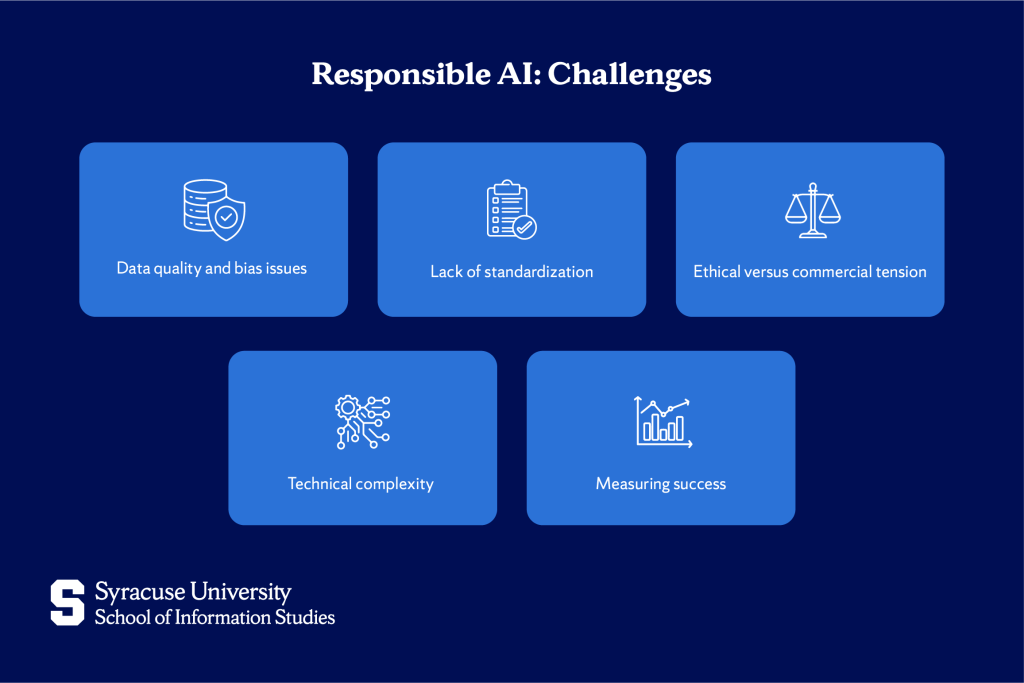
These challenges aren’t reasons to avoid responsible AI. Instead, they are the reasons why it requires dedicated effort, resources, and expertise. Organizations that invest in addressing these challenges now will be better positioned as regulations tighten and public expectations continue rising.
The Future of Responsible AI
The field of responsible AI is moving fast, with several trends set to define its direction in the next decade.
Stronger regulations are coming. Following the EU’s AI Act, we’ll likely see more countries and regions establish comprehensive AI laws. These regulations will probably distinguish between high-risk and low-risk AI applications, with stricter requirements for systems that significantly affect people’s rights or safety.
AI safety research is expanding. Universities and research labs are investing heavily in understanding how to make AI systems more reliable, interpretable, and aligned with human values. This includes work on detecting and preventing AI failures, making models more robust against attacks, and developing better methods for explaining complex AI decisions. Syracuse iSchool contributes to this research through its focus on human-centered computing and information ethics.
Automated ethics checks may become standard. By 2030, we might see AI systems that can detect bias or fairness issues in other AI systems automatically. Just as we have automated security testing today, automated ethics testing could become part of standard development workflows. This won’t replace human judgment, but it could catch problems earlier and more consistently.
Self-regulating AI remains a distant goal. While intriguing, the concept of AI systems that can monitor and correct their own ethical issues faces significant technical and philosophical challenges. For the foreseeable future, human oversight will remain essential, especially for high-stakes decisions.
New roles will emerge. We’ll see growing demand for professionals who combine technical AI knowledge with ethics, policy, and social science expertise. These roles (AI ethicists, AI auditors, AI policy specialists) represent exciting career paths for students interested in technology’s societal impact.
Final Thoughts on Responsible AI
Building trustworthy AI isn’t optional anymore; it’s essential for any organization that wants to maintain credibility and comply with emerging regulations.
Fairness, transparency, accountability, robustness, and privacy provide a roadmap. But principles alone aren’t enough. Organizations need to translate these ideas into concrete practices, governance structures, and team capabilities.
This is exactly the kind of interdisciplinary challenge that requires both technical skill and critical thinking. You need to understand how AI works and how it affects people. You need to bridge computer science, ethics, policy, and domain expertise.
If you’re interested in being part of this transformation, iSchool’s Applied Human-Centered Artificial Intelligence Master’s Degree prepares students to design and manage AI systems that are transparent, ethical, and human-focused. It integrates technical coursework with studies in information ethics, governance, and social impact, equipping graduates to lead responsibly in an AI-driven world.
Frequently Asked Questions (FAQs)
What is the difference between responsible AI and AI?
AI refers to any system that can perform tasks typically requiring human intelligence, like recognizing images, processing language, or making predictions. Responsible AI is a framework for how we build and use these systems. It adds ethical considerations like fairness, transparency, and accountability to ensure AI benefits everyone and doesn’t cause unintended harm. Think of AI as the technology itself, and responsible AI as the principles that guide how we develop and deploy that technology ethically.
What industries benefit most from adopting responsible AI practices?
Industries that impact people’s lives gain the most from responsible AI. Healthcare uses it to improve diagnostic fairness, finance to prevent lending bias, education to ensure fair evaluations, and government to deliver equitable services. Tech and HR fields also rely on it to create trustworthy products and unbiased hiring. Wherever AI influences welfare or opportunity, responsibility is essential.