
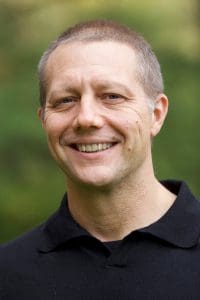
 For Josh Introne, beliefs are a bit like the weather. The associate professor at the iSchool studies how ideas cluster and shift across a population—much like currents in a changing atmosphere. Introne recently received a one-year, $300,000 grant from the Defense Advanced Projects Research Agency (DARPA) to map these “belief weather patterns” with a new kind of forecasting tool.
“I’m so excited about this grant,” Introne said. “I’ve been working on this project for years, since I started at Syracuse University, so it’s gratifying to see it advance.”
The project, “Predicting Belief Evolution In Non-Ergodic Systems,” builds on Introne’s ongoing research into how population beliefs change over time.
“I envision beliefs as a big, high-dimensional space,” Introne said. “Individuals—holding vast numbers of beliefs—move through that space in distinct patterns, and people with similar beliefs move in similar ways.” He compares it to leaves drifting in a stream. While the currents aren’t visible, their direction can be inferred from the leaves’ movement.
“I want to understand these belief patterns to develop better predictive models, diagnose polarization, and even anticipate extremist events or conflicts,” Introne explained. “These are not abstract mathematical ideas—they have real-world impact.”
With doctoral student Mia Huiqian Lai, Introne is analyzing a decade of Reddit and Twitter data, along with news articles. “The years 2013 to 2023 include key events like COVID, the Me Too movement, and the 2016 and 2020 elections,” he said.
While social media data allows for surprisingly accurate predictions about individual beliefs over time, Introne focuses on global patterns. His goal is to develop a “physics of belief” that accounts for non-ergodicity—where past patterns don’t reliably repeat. Models can become outdated as language evolves (for example, “corona” went from primarily being known as a Mexican beer to referring to a virus) or as beliefs change political alignment (such as anti-vax attitudes spreading across ideological groups).
The belief landscape framework tracks how pockets of belief shift over time. It identifies when the system reaches a tipping point, showing “critical slowing”— recovering more slowly from shocks and making it fragile and primed for major events at the level of the Arab Spring or the George Floyd protests.
For the current project, Introne is focusing on beliefs and issues that are likely to impact national security—including social unrest, pandemics, and big market changes. “But certainly other sorts of indicators would be useful for predicting global events, like looking at population changes, financial signals, corruption levels of different governments,” he said.
And in the long run, Introne hopes his modeling can help improve or even replace traditional opinion polling as a more flexible and realistic way to understand public sentiment, not by asking survey questions but by observing natural conversations.
“We might develop a metric to assess whether our public discourse is healthy and resilient,” Introne suggested. “These insights could guide better deliberative tools—but any work must be guided by a strong ethical stance.”